

GST Calculator Online: Add or Remove GST Instantly
Use the free GST calculator Online below to add GST to a base price or remove GST from a GST-inclusive amount. Enter any amount, select the applicable rate (5%, 12%, 18%, or 28%), and get the GST amount, CGST/SGST split for intra-state sales, and IGST for inter-state sales instantly. All four standard GST rates used in India are supported.
Contents
- How Do You Add GST to a Price (GST Exclusive Calculation)?
- How Do You Remove GST from a Price (GST Inclusive Calculation)?
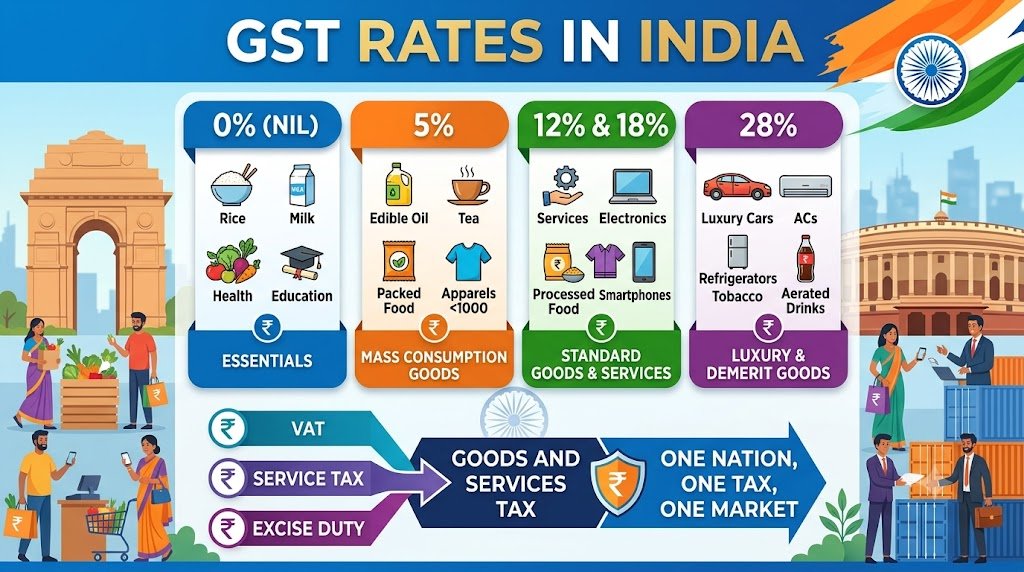
- What Are the GST Rates in India and Which Rate Applies to Your Product?
- What Is the Difference Between CGST, SGST, and IGST?
- How Do GST Inclusive and GST Exclusive Prices Appear on an Invoice?
- When Is GST Applicable and Who Must Collect It?
- What Are the Most Common Questions About the GST Calculator?
How Do You Add GST to a Price (GST Exclusive Calculation)?
A GST exclusive price is the base price of goods or services before any GST is applied. When a registered supplier issues an invoice to a business buyer (B2B), the price is typically quoted exclusive of GST, and the GST is shown as a separate line item. To add GST to any base amount, the formula is:
Total Amount = Base Amount + GST Amount
CGST = GST Amount ÷ 2 (intra-state only)
SGST = GST Amount ÷ 2 (intra-state only)
IGST = GST Amount (inter-state only)
GST Exclusive Examples at All 4 Rates (Base Amount: Rs 10,000)
| GST Rate | Base Amount | GST Amount | CGST | SGST | IGST (inter-state) | Total (incl. GST) |
|---|---|---|---|---|---|---|
| 5% | Rs 10,000 | Rs 500 | Rs 250 (2.5%) | Rs 250 (2.5%) | Rs 500 (5%) | Rs 10,500 |
| 12% | Rs 10,000 | Rs 1,200 | Rs 600 (6%) | Rs 600 (6%) | Rs 1,200 (12%) | Rs 11,200 |
| 18% | Rs 10,000 | Rs 1,800 | Rs 900 (9%) | Rs 900 (9%) | Rs 1,800 (18%) | Rs 11,800 |
| 28% | Rs 10,000 | Rs 2,800 | Rs 1,400 (14%) | Rs 1,400 (14%) | Rs 2,800 (28%) | Rs 12,800 |
How Do You Remove GST from a Price (GST Inclusive Calculation)?
A GST inclusive price is the final consumer-facing price after GST has already been added. MRP-tagged products, restaurant bills (where GST is bundled), and some contracts quote GST-inclusive prices. To find the original base amount and the GST component from an inclusive price, you must use the reverse formula:
GST Amount = Total Amount − Base Amount
CGST = GST Amount ÷ 2 (intra-state)
SGST = GST Amount ÷ 2 (intra-state)
IGST = GST Amount (inter-state)
GST Inclusive Examples at All 4 Rates (Inclusive Total: Rs 10,000)
| GST Rate | Total (incl. GST) | Divisor | Base Amount (excl. GST) | GST Amount | CGST | SGST |
|---|---|---|---|---|---|---|
| 5% | Rs 10,000 | 1.05 | Rs 9,523.81 | Rs 476.19 | Rs 238.10 | Rs 238.10 |
| 12% | Rs 10,000 | 1.12 | Rs 8,928.57 | Rs 1,071.43 | Rs 535.71 | Rs 535.71 |
| 18% | Rs 10,000 | 1.18 | Rs 8,474.58 | Rs 1,525.42 | Rs 762.71 | Rs 762.71 |
| 28% | Rs 10,000 | 1.28 | Rs 7,812.50 | Rs 2,187.50 | Rs 1,093.75 | Rs 1,093.75 |
Common Error: Do Not Calculate GST as a Percentage of the Inclusive Price
The most frequent mistake when removing GST from an inclusive price is to calculate GST as a percentage of the total. For example, if the inclusive price is Rs 10,000 at 18% GST, the wrong approach is: 18% of Rs 10,000 = Rs 1,800. The correct GST is Rs 1,525.42 (not Rs 1,800). The correct method divides by 1.18, not multiplies by 0.18. Multiplying the inclusive price by the tax rate overstates the GST and understates the base amount, leading to incorrect input tax credit claims in GSTR-3B and errors in GST return filings.
What Are the GST Rates in India and Which Rate Applies to Your Product?
| Category | Rate | Common Examples |
|---|---|---|
| Exempt / Nil | 0% | Fresh fruits, vegetables, milk, eggs, unbranded food grains, health services, educational services, postal services |
| Essential goods | 5% | Sugar, tea, coffee, edible oils, coal, handmade carpets, economy class air travel, fertilizers |
| Standard goods | 12% | Processed or frozen meat, butter, cheese, namkeen, mobile phones, computers, business class air travel |
| Standard services and goods | 18% (most common) | Professional services (CA, lawyer, architect, IT), restaurants (AC), construction, most electronics, steel, paints, chemicals, hair oil, soaps, toothpaste |
| Luxury and demerit goods | 28% | Cars (except electric vehicles), motorcycles (above 350cc), tobacco, aerated drinks, cement, tiles, washing machines, air conditioners, dishwashers |
How to Find the Exact GST Rate for Your HSN/SAC Code
GST rates are assigned based on the Harmonised System of Nomenclature (HSN) code for goods or the Service Accounting Code (SAC) for services. If you are unsure which rate applies to your product or service, search by HSN or SAC code on the CBIC GST rate finder at cbic.gov.in. The GST Council periodically revises rates; always verify the current rate before raising an invoice. Businesses with turnover above Rs 5 crore must mandatorily mention the 6-digit HSN code on their invoices; those between Rs 1.5 crore and Rs 5 crore must use 4-digit HSN codes.
What Is the Difference Between CGST, SGST, and IGST?
When a GST transaction occurs, the tax collected is split between the central government and the state government based on whether the sale is within the same state (intra-state) or across state borders (inter-state). The applicable tax type determines which government receives the revenue.
| Tax Type | Full Form | Applies When | Revenue Goes To | Rate (at 18% total) |
|---|---|---|---|---|
| CGST | Central Goods and Services Tax | Supplier and buyer are in the SAME state (intra-state) | Central Government | 9% (half of 18%) |
| SGST | State Goods and Services Tax | Supplier and buyer are in the SAME state (intra-state) | State Government | 9% (half of 18%) |
| UTGST | Union Territory GST | Buyer is in a Union Territory without legislature (e.g. Dadra, Lakshadweep) | Union Territory | 9% (half of 18%) |
| IGST | Integrated Goods and Services Tax | Supplier and buyer are in DIFFERENT states (inter-state) or imports | Central Government (then apportioned to destination state) | 18% (full rate) |
On a GST invoice, only one type applies: either CGST + SGST (for intra-state), or IGST (for inter-state). Never both on the same invoice line. The total GST rate is always the same (e.g., 18%) regardless of whether it is split as CGST+SGST or charged as IGST; the difference is only in how the revenue is divided between governments.
How Do GST Inclusive and GST Exclusive Prices Appear on an Invoice?
A valid GST tax invoice under the CGST Act 2017 must show the GST separately from the taxable value (base price). The invoice cannot simply show a single final amount without disclosing the GST component. This means the standard GST invoice format is always GST exclusive (showing base price and GST as separate line items), even if the contract was quoted at an inclusive price.
| Invoice Line | 18% GST Example (Rs 10,000 base) | Notes |
|---|---|---|
| Description of goods/services | IT Consulting Services | With HSN/SAC code (998314 for IT consulting) |
| Taxable Value | Rs 10,000.00 | Base amount (GST exclusive price) |
| CGST @ 9% | Rs 900.00 | Intra-state only; not shown for inter-state |
| SGST @ 9% | Rs 900.00 | Intra-state only; not shown for inter-state |
| IGST @ 18% | Rs 1,800.00 | Inter-state only; replaces CGST+SGST |
| Total Invoice Amount | Rs 11,800.00 | Amount payable by buyer (inclusive of GST) |
If you agreed on a GST-inclusive price with your client (e.g., Rs 11,800 all-in), your invoice must still break it down: Taxable Value Rs 10,000 + CGST Rs 900 + SGST Rs 900 = Rs 11,800 total. Use the Remove GST tab of the calculator above to compute the taxable value from the inclusive price you quoted. This breakdown is also needed for your GSTR-1 and GSTR-3B filings on the GST portal at gst.gov.in.
When Is GST Applicable and Who Must Collect It?
GST registration is mandatory when a business’s annual aggregate turnover exceeds the registration threshold. As of FY 2025-26, the thresholds are:
| Business Type | Mandatory Registration Threshold | Notes |
|---|---|---|
| Goods supplier (most states) | Rs 40 lakh turnover per year | Reduced to Rs 20 lakh in special category states (NE states, Himachal, J&K, etc.) |
| Service provider (all states) | Rs 20 lakh turnover per year | Rs 10 lakh in special category states |
| E-commerce sellers | No threshold; registration from Day 1 | Any seller on Amazon, Flipkart, etc. must register for GST regardless of turnover |
| Inter-state suppliers | No threshold; registration from Day 1 | Any supplier making inter-state taxable supplies must register regardless of turnover |
| Composition scheme | Turnover up to Rs 1.5 crore (goods) or Rs 50 lakh (services) | Simplified quarterly filing; cannot collect GST from buyers; pay flat rate on turnover |
Businesses below the registration threshold can register voluntarily. Voluntary registration allows the business to collect GST from buyers, claim input tax credit on purchases, and participate in B2B supply chains that require a GST invoice. If your buyer demands a GST invoice and your turnover is below the threshold, voluntary registration is the right option. Note that MSME-registered businesses can be below the GST threshold and still have valid MSME status.
GST Calculator: Quick Reference
- Add GST (exclusive): Total = Base × (1 + rate/100) • e.g., Rs 10,000 × 1.18 = Rs 11,800 at 18%
- Remove GST (inclusive): Base = Total ÷ (1 + rate/100) • e.g., Rs 11,800 ÷ 1.18 = Rs 10,000
- CGST = SGST = half the GST for intra-state supply
- IGST = full GST for inter-state supply
- GST is never calculated on GST: always apply the rate to the base (taxable) value only
- GST rates: 0% (exempt), 5% (essential), 12% (standard goods), 18% (most services and goods), 28% (luxury)
- Composition dealers cannot charge GST to buyers and cannot issue tax invoices; they issue bill of supply
What Are the Most Common Questions About the GST Calculator?
What is the formula to add GST to a price (GST exclusive calculation)?
To add GST to a base price, use: GST Amount = Base Price multiplied by (GST Rate divided by 100), and Total Price = Base Price + GST Amount. For a base price of Rs 10,000 at 18% GST: GST Amount = Rs 10,000 × 18/100 = Rs 1,800, and Total = Rs 11,800. For intra-state sales, split the GST as CGST = Rs 900 (9%) and SGST = Rs 900 (9%). For inter-state sales, charge IGST = Rs 1,800 (18%). Always enter the base price (excluding GST) in the Add GST tab of the calculator above.
What is the formula to remove GST from a GST-inclusive price?
To remove GST from a GST-inclusive price, use: Base Price = Total Price divided by (1 + GST Rate / 100), and GST Amount = Total Price minus Base Price. For a GST-inclusive total of Rs 11,800 at 18%: Base Price = Rs 11,800 / 1.18 = Rs 10,000, and GST = Rs 1,800. A common error is to multiply the inclusive price by the rate (Rs 11,800 × 18% = Rs 2,124), which incorrectly overstates GST by Rs 324. Use the Remove GST tab of the calculator above for accurate results instantly.
What is the difference between a GST inclusive price and a GST exclusive price?
A GST exclusive price is the price before GST is added; it is also called the taxable value on a GST invoice. The buyer pays the exclusive price plus GST on top. A GST inclusive price is the total final price after GST has been added; it is the amount the buyer pays. A GST tax invoice must always show the taxable value and the GST amount separately, even if the contract was quoted at an inclusive price. To convert an inclusive quote to an invoice, use the Remove GST calculator to find the taxable value, then show taxable value + CGST + SGST (or IGST) = total invoice value. File the taxable value and GST amounts separately in GSTR-1 on the GST portal at gst.gov.in.
How is CGST and SGST calculated from the total GST amount?
CGST and SGST are each exactly half the total GST amount for intra-state supplies. The GST rate stated in the rate schedule (e.g., 18%) is always the combined CGST + SGST rate; CGST is 9% and SGST is 9% of the taxable value. IGST is the full 18% and applies to inter-state supplies or imports. For example, on a taxable value of Rs 50,000 at 18%: CGST = Rs 50,000 × 9% = Rs 4,500; SGST = Rs 4,500; Total GST = Rs 9,000. For inter-state: IGST = Rs 50,000 × 18% = Rs 9,000. The buyer who pays IGST can later claim it as input tax credit against IGST, CGST, or SGST liability in their GST returns.
What GST rate applies to services like professional fees, software, and consulting?
Most professional and business services in India attract GST at 18%, including fees of Chartered Accountants, lawyers, architects, engineers, management consultants, and IT or software services. Key exceptions at lower rates include: economy-class air transport (5%), transport of goods by road (5%), hotel accommodation under Rs 7,500 per night (12%). Services that are completely exempt from GST include healthcare by clinical establishments, educational services by recognized institutions, and certain financial services. If your business provides professional services and your annual turnover exceeds Rs 20 lakh (Rs 10 lakh in special category states), you must register for GST, charge 18% GST on your invoices, and file GSTR-1 and GSTR-3B monthly or quarterly as applicable.