

GST Rate List with HSN SAC Search and Calculator
Search any product or service name, or enter an HSN/SAC code below to instantly find the applicable GST rate for FY 2025-26. The integrated calculator lets you add GST to a base price or remove GST from an inclusive total, with a full CGST, SGST, and IGST breakdown.
Contents
- What Is the GST Rate List and How Do HSN and SAC Codes Work?
- What Are the 5 GST Rate Slabs and What Do They Cover?
- What Is the GST Rate for Common Goods Under HSN Codes?
- What Is the GST Rate for Common Services Under SAC Codes?
- How Do You Use the HSN Code to Find the Correct GST Rate on Your Invoice?
- What Changes Did the GST Council Make to Rates for FY 2025-26?
- What Are the Most Common Questions About GST Rates and HSN Codes?
What Is the GST Rate List and How Do HSN and SAC Codes Work?
The GST rate list is the official schedule of Goods and Services Tax rates applicable to every product and service in India, published by the Central Board of Indirect Taxes and Customs (CBIC) at cbic.gov.in. Each entry in the rate list is identified by a code: the Harmonised System of Nomenclature (HSN) code for goods, and the Service Accounting Code (SAC) for services.
HSN codes are an internationally standardised classification system developed by the World Customs Organization. India uses a 6-to-8 digit HSN code structure where the first 2 digits represent the chapter (broad category), the next 2 digits the heading (subcategory), and the final 2-4 digits the subheading (specific product). SAC codes are a 6-digit Indian system for classifying services into categories that correspond to GST rate notifications. Both HSN and SAC codes must appear on GST invoices and in monthly GSTR-1 filings on the portal at gst.gov.in.
HSN vs SAC: Key Differences
- HSN (Harmonised System of Nomenclature): For goods. 2, 4, 6, or 8 digits. Internationally standardised. Chapters 1-97 cover all goods.
- SAC (Service Accounting Code): For services. Always 6 digits. India-specific. Codes start from 9954 onwards for most services (Section 9 of the SAC list).
- Rate notifications: Goods rates are in CGST Notification No. 1/2017-CT(Rate); service rates in Notification No. 11/2017-CT(Rate), both with subsequent amendments.
- 4-digit vs 6-digit on invoices: Businesses with turnover up to Rs 5 crore: 4-digit HSN on B2B invoices. Above Rs 5 crore: 6-digit HSN on all invoices.
- Verify before filing: Rates change after each GST Council meeting. Always cross-check on cbic.gov.in before filing a return.
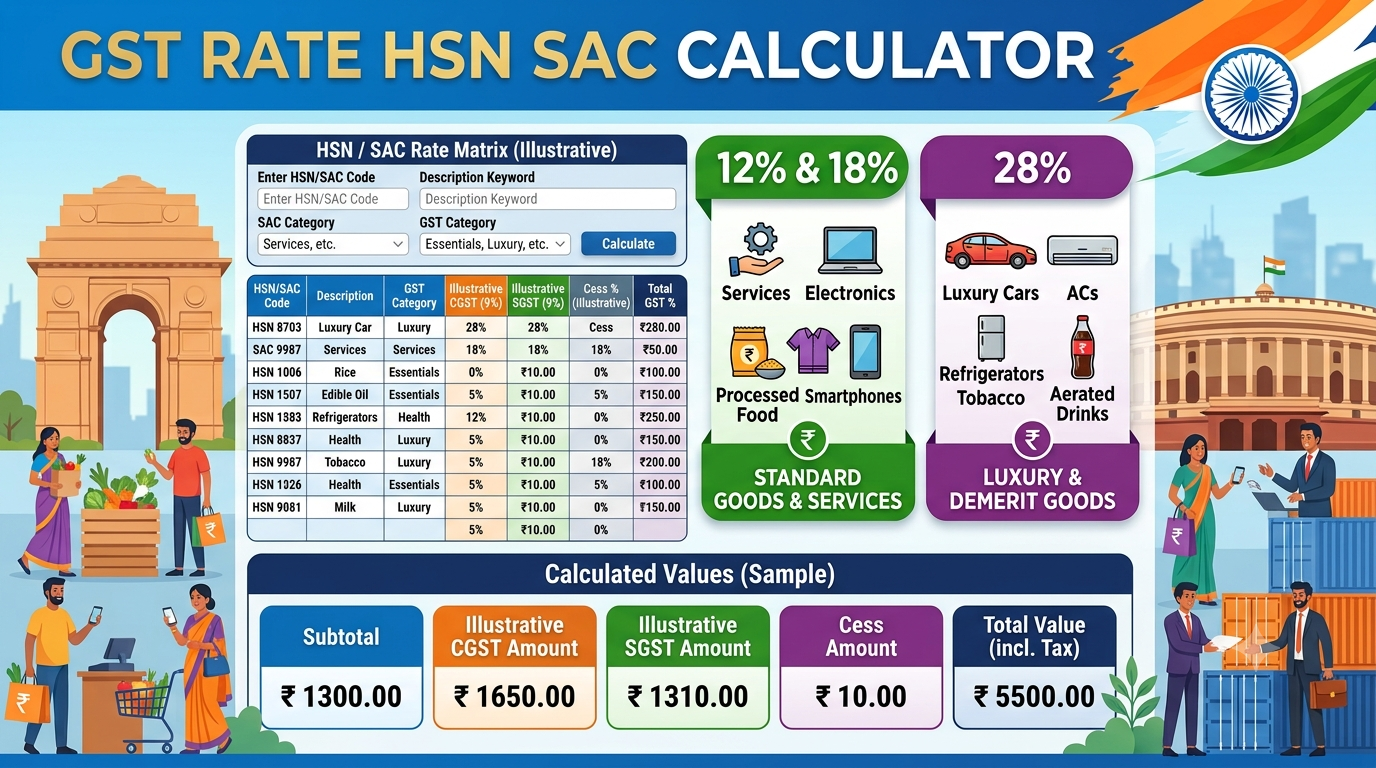
What Are the 5 GST Rate Slabs and What Do They Cover?
The 0% category is further divided into truly “exempt” supplies (where no GST applies and no input tax credit is available to the supplier) and “nil-rated” supplies (where GST is 0% but the legal framework still applies). Additionally, exports of goods and services are “zero-rated” under Section 16 of the IGST Act, meaning GST is 0% AND the exporter can claim a full refund of input tax credit used in producing the exported goods or services.
What Is the GST Rate for Common Goods Under HSN Codes?
| HSN | Product | GST Rate | CGST | SGST/UTGST |
|---|---|---|---|---|
| 1701 | Sugar | 5% | 2.5% | 2.5% |
| 0902 | Tea (packaged and branded) | 5% | 2.5% | 2.5% |
| 0901 | Coffee (roasted, ground; not instant) | 5% | 2.5% | 2.5% |
| 0901 | Instant coffee, coffee extracts | 18% | 9% | 9% |
| 0405 | Butter and ghee | 12% | 6% | 6% |
| 0403 | Cheese | 12% | 6% | 6% |
| 3004 | Medicines (prescription, retail packs) | 5% | 2.5% | 2.5% |
| 3305 | Shampoo, hair oil | 18% | 9% | 9% |
| 3306 | Toothpaste | 18% | 9% | 9% |
| 3401 | Soaps and detergents | 18% | 9% | 9% |
| 8517 | Mobile phones and smartphones | 12% | 6% | 6% |
| 8471 | Computers, laptops, tablets, printers | 18% | 9% | 9% |
| 8528 | Televisions (up to 32 inches) | 18% | 9% | 9% |
| 8528 | Televisions (above 32 inches) | 28% | 14% | 14% |
| 8415 | Air conditioners | 28% | 14% | 14% |
| 8703 | Passenger motor vehicles (petrol/diesel) | 28% | 14% | 14% |
| 8703 | Electric vehicles (EVs) | 5% | 2.5% | 2.5% |
| 2523 | Cement (all types) | 28% | 14% | 14% |
| 3208 | Paints and varnishes | 18% | 9% | 9% |
| 2402 | Cigarettes and tobacco products | 28% | 14% | 14% |
| 2701 | Coal | 5% | 2.5% | 2.5% |
| 8502 | Solar panels and photovoltaic modules | 5% | 2.5% | 2.5% |
What Is the GST Rate for Common Services Under SAC Codes?
| SAC | Service | GST Rate | Notes |
|---|---|---|---|
| 9983 | CA, audit, tax consulting, management consulting | 18% | Reverse charge applies for legal services to business entities |
| 9982 | Legal services (lawyers, advocates) | 18% | Reverse charge when service receiver is a business entity |
| 9985 | IT software, SaaS, cloud computing, data processing | 18% | Export of IT services is zero-rated (0% with ITC refund) |
| 9984 | Telecom and internet services | 18% | Includes mobile recharge, broadband, DTH |
| 9971 | Banking, insurance, stockbroking, portfolio management | 18% | Some banking services are exempt (no-frills accounts) |
| 9987 | Repair of vehicles, appliances, machinery | 18% | Spare parts attract applicable goods rate separately |
| 9997 | Beauty salon, spa, hair cutting services | 18% | Threshold: register if turnover exceeds Rs 20 lakh |
| 9963 | Restaurant, café, catering (AC, with ITC) | 18% | 5% if restaurant opts for no-ITC composition scheme |
| 9963 | Hotel accommodation (Rs 7,501 and above per night) | 18% | Rooms up to Rs 1,000/night: 12%; up to Rs 7,500: 12% |
| 9954 | Construction of commercial buildings | 18% | Residential (non-affordable): 12%; affordable housing: 5% |
| 9964 | Air travel (economy class) | 5% | Business class: 12%; charter aircraft: 18% |
| 9967 | Goods transport by road (GTA) | 5% | Reverse charge applicable if recipient is registered |
| 9992 | Educational institution services | 0% | Recognized schools, colleges, universities only |
| 9993 | Hospital, nursing home, medical services | 0% | All authorized clinical establishments |
| 9996 | Online gaming, casinos, race clubs (real money) | 28% | Applied on full face value from October 2023 GST Council decision |
How Do You Use the HSN Code to Find the Correct GST Rate on Your Invoice?
- Identify the primary product or service you are supplying. For goods, think in terms of what the item is at its most fundamental level (raw material vs. processed, packaged vs. unpackaged, etc.).
- Search the CBIC rate schedules using the search tool above or the official GST rate finder at cbic.gov.in. Enter a keyword or, if you know the broad chapter, navigate from the 2-digit chapter code down to the 4 or 6-digit heading.
- Determine the correct variation. Many HSN codes have different rates depending on whether the goods are branded or unbranded, packaged or loose, above or below a price threshold. For example, rice is nil-rated when unpackaged and 5% when pre-packaged and labelled.
- Check for cess. Some goods (cigarettes, aerated drinks, luxury vehicles) attract a GST Compensation Cess over and above the 28% GST rate. The cess is charged separately and not reflected in the basic GST rate.
- Mention the HSN/SAC on your invoice in the correct digit count (4-digit for turnover up to Rs 5 crore on B2B invoices; 6-digit for above Rs 5 crore on all invoices). Incorrect HSN codes lead to mismatches in GSTR-2B, block input tax credit for your buyer, and can attract notices and penalties under Section 122 of the CGST Act 2017.
How Section 43B(h) Links GST Invoices to Income Tax Compliance for MSME Suppliers
If your MSME certificate (Udyam Registration) classifies you as a Micro or Small Enterprise, your GST invoices serve a dual purpose. Beyond the standard GST return obligations, your invoice is the trigger document for the Section 43B(h) income tax protection: the invoice date plus 45 days (or 15 days if no written agreement) is the deadline by which your buyer must pay, or face a tax disallowance. Always ensure your invoice mentions your Udyam Registration Number so buyers are aware that Section 43B(h) applies.
What Changes Did the GST Council Make to Rates for FY 2025-26?
The GST Council meets periodically to review and revise rates. Key rate changes effective in FY 2025-26 include:
| Item / Category | Old Rate | New Rate (FY 2025-26) | Effective From |
|---|---|---|---|
| Online gaming (real money games, casinos) | 18% on platform fee | 28% on full face value of bets | October 2023 (continues in FY 2025-26) |
| Cancer treatment drugs (specific) | 12% | 5% | Per 53rd GST Council recommendation |
| Insurance premiums (term life, health) | 18% | Reduction under review (not yet finalized) | Pending notification |
| Popcorn in cinema halls | 18% | Classified at applicable goods rate (5%/12%/18% by type) | Clarified in FY 2025-26 |
| Used EVs sold by businesses | 18% | 18% on margin (clarified) | Applicable FY 2025-26 |
Always Verify Rates at CBIC Before Filing GST Returns
The GST rate list on this page reflects rates as of September 2026 and is provided for guidance. Rates change after every GST Council meeting, and the official notification (CGST Rate Notification or IGST Rate Notification) published by CBIC is the only authoritative source. Using an outdated rate on a GST invoice results in either excess GST collection (requiring refund or adjustment in GSTR-3B) or short collection (creating a tax liability with interest under Section 50 of the CGST Act). For any supply where you are unsure of the rate, check the current applicable notification at cbic.gov.in before raising the invoice. If you receive a GSTR-3A notice or an audit notice from GST authorities, verify all HSN codes in your returns.
What Are the Most Common Questions About GST Rates and HSN Codes?
How do I find the GST rate for my product using its HSN code?
Enter the HSN code or product name in the search box at the top of this page to find the GST rate instantly. For a formal lookup, visit the CBIC GST Rate Finder at cbic.gov.in and search by HSN code or product description. The rate schedules are also available in the CGST Rate Notification (No. 1/2017-Central Tax Rate) and subsequent amendment notifications. If you know the 2-digit HSN chapter, the chapter-level schedule quickly narrows the search. For disputed or novel products, the advance ruling mechanism under Section 97 of the CGST Act allows a taxpayer to formally ask the Authority for Advance Ruling (AAR) to determine the applicable GST rate.
What is the GST rate on IT services, consulting, and professional fees in 2025-26?
IT services (SAC 9985), software development, data processing, cloud computing, and most business support services attract GST at 18%. Chartered accountant and audit fees (SAC 9983), management consulting, and tax advisory also attract 18% GST. Legal services (SAC 9982) are taxable at 18%, with reverse charge applicable when an advocate provides services to a business entity registered under GST. Educational institution services (SAC 9992) and hospital or clinical services (SAC 9993) are exempt at 0%. Export of IT services (when the place of supply is outside India and payment is in convertible foreign exchange) is zero-rated, allowing exporters to claim refund of input tax credit on inputs.
Is GST on exports 0% or exempt, and what is the difference?
Exports of goods and services are zero-rated under Section 16 of the IGST Act 2017, which is legally different from being exempt. Zero-rated means GST at 0% is charged on the export supply AND the exporter is entitled to a full refund of input tax credit (ITC) paid on inputs, input services, and capital goods used to produce the exported goods or services. This distinguishes zero-rated from exempt: providers of truly exempt supplies (e.g., healthcare, education) cannot claim ITC on their inputs, while exporters can and do claim full ITC refunds. IGST-paid exports can claim refund under Rule 96 of the CGST Rules; LUT-based zero-rated exports claim ITC refund under Rule 89.
What are the HSN code digit requirements on GST invoices for FY 2025-26?
The mandatory HSN digit count on GST invoices depends on annual aggregate turnover: businesses with turnover up to Rs 5 crore are exempt from HSN on B2C invoices but must use 4-digit HSN on B2B invoices; businesses with turnover above Rs 5 crore must use a 6-digit HSN code on all invoices. For services, the 6-digit SAC code is mandatory on all tax invoices regardless of turnover. HSN and SAC summary details must also be mentioned in GSTR-1 (outward supply return) filed monthly or quarterly on the GST portal. Incorrect or missing HSN codes are flagged in GSTR-2B auto-drafting and can block input tax credit claims of your buyers.
Which goods and services attract GST at 28% in India?
The 28% GST rate applies to luxury goods and demerit goods. Goods at 28%: passenger motor vehicles with petrol or diesel engines (HSN 8703); motorcycles above 350cc (HSN 8711); all cigarettes, cigars, and tobacco products (HSN 2402-2403); air conditioners (HSN 8415); washing machines above 10 kg (HSN 8450); dishwashers (HSN 8422); televisions above 32 inches; cement (HSN 2523); glazed ceramic floor and wall tiles. Services at 28%: online gaming with real money bets, casino services, race clubs, and amusement parks. Many 28% goods also carry an additional GST Compensation Cess (e.g., cigarettes attract cess of Rs 5 per stick or a percentage, and luxury cars attract 22% cess). To check the anti-profiteering rules if you have reduced rates, see our dedicated guide.